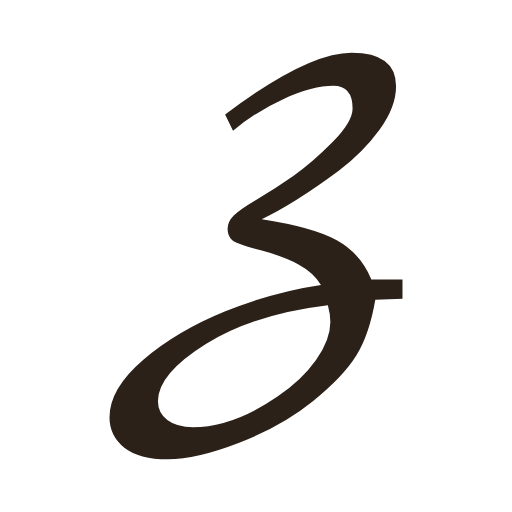
З, the Russian cursive letter ze
З is the Cyrillic letter Ze, which carries the /z/ of the English word zulu. Its shape runs close to two other marks a reader meets on the page: the Arabic numeral three, and the Cyrillic letter Э.
In words
здравствуй · hello
жизнь · life
Easy to confuse with
Looks like Э (Cyrillic E)
The Ze article names this pair directly and warns against reading one for the other. The resemblance is a matter of shape: З is the letter that carries /z/, while Э is a separate letter of the alphabet rather than a variant of З. The same article notes that З also runs close in shape to the Arabic numeral three, so where a line mixes words and figures, settle first whether the mark is a letter at all.

History
З is the Cyrillic letter Ze. It commonly represents the voiced alveolar fricative /z/, the sound of the letter z in the English word zulu, and it is romanised with the Latin letter z.
Two resemblances are worth holding in mind when reading З off a page. The shape of Ze is very similar to the Arabic numeral three, which is worth remembering wherever handwritten words and figures sit side by side. It should also not be confused with the Cyrillic letter Э, which is a separate letter of the alphabet and not a variant of З. Neither of these is a cursive matter in particular: the ambiguities documented for Russian cursive gather around и, л, м, ш, щ and ы, a group built from one shared element, and З stands outside it.
Russian cursive was developed during the 18th century on the base of the earlier Cyrillic tachygraphic writing known as skoropis, meaning rapid or running script, which was in turn the chancery hand of the 14th to 17th centuries, descended from the earlier Cyrillic bookhands called ustav and poluustav. It became the handwritten counterpart of the civil, or Petrine, printed script of books.
The reform carried out after 1917 changed the rule governing prefixes ending in з or с, which is one of the things that separates an older document from a newer one. In the modern spelling all of them, apart from с-, end in с before a voiceless consonant and in з before a voiced consonant or a vowel, giving разбить and разораться but расступиться. Before the change the prefixes showed a concurrence between phonetic and morphological spellings. At the end of the 19th century and the beginning of the 20th, the standard rule kept с-, без- and ч(е)рез- in one fixed form, while other prefixes ended in с before voiceless consonants apart from с and in з otherwise, so that разступиться was written where расступиться now stands. Earlier 19th-century works also sometimes used з before ц, ч, ш и щ.