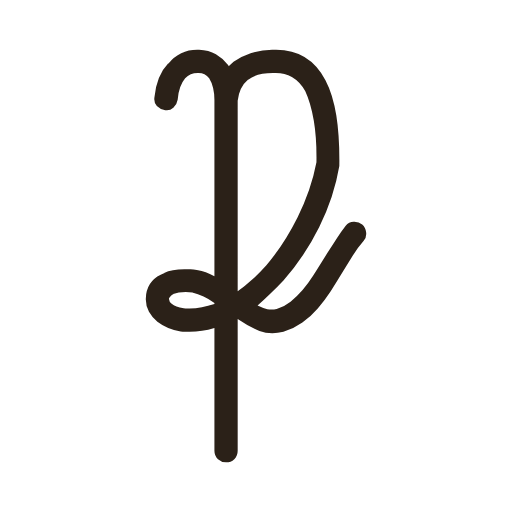
P, the Sütterlin letter p
P is the 16th letter of the German alphabet, representing a voiceless bilabial plosive /p/, found in Germanic words and loanwords. In Sütterlinschrift, it was redesigned in 1911 by Ludwig Sütterlin with upright, geometric proportions for German schoolchildren.
In words
Pfarrer · pastor

History
The letter P is the 16th letter of the German alphabet. Phonetically, it represents a voiceless bilabial plosive /p/, found in Germanic words and loanwords.
Sütterlin lowercase p has a straight, vertical descender dropping below the baseline and a round circular bowl in the middle zone. Capital P is written with an upright vertical stroke and a clean, rounded upper bowl.
In historical German church registers, p appears in clerical titles and religious roles such as 'Pfarrer' (pastor), 'Pate' (godparent), 'Pfarrei' (parish), and 'Proklamation' (banns of marriage). Its descender makes it readily visible.
P may go back to a Proto-Sinaitic throwing stick,[1] though the literature accepts that origin only in part.[2] What is certain is a Phoenician letter named pe, mouth.[3] The uprights of Greek pi, at first of different lengths, were made equal by the classical alphabet,[4] and Latin took P in its Etruscan form and mirrored it when the writing direction changed to left to right.[5]
Sources
- [1] P — Wikipedia (German) — possibly a throwing stick (accessed 2026-10-14)
- [2] P — Wikipedia (German) — only partly accepted (accessed 2026-10-14)
- [3] P — Wikipedia (German) — Phoenician pe, mouth (accessed 2026-10-14)
- [4] P — Wikipedia (German) — pi's strokes made equal (accessed 2026-10-14)
- [5] P — Wikipedia (German) — Latin P mirrored (accessed 2026-10-14)