M, the Sütterlin letter m
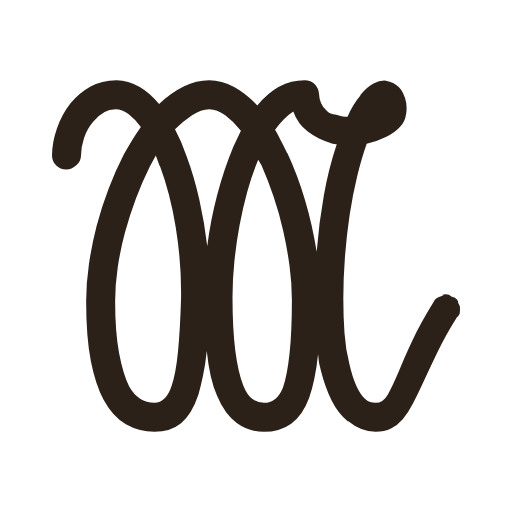
M is the 13th letter of the German alphabet, representing a voiced bilabial nasal /m/, occurring in all word positions and grammatical affixes. In Sütterlinschrift, it was redesigned in 1911 by Ludwig Sütterlin with upright, geometric proportions for German schoolchildren.
In words
Mutter · mother
Easy to confuse with
Looks like n (Sütterlin n)
The m has three downstrokes and the n two. A straight bar above either one doubles it (mm, nn) and is not a stroke of the letter.

History
The letter M is the 13th letter of the German alphabet. Phonetically, it represents a voiced bilabial nasal /m/, occurring in all word positions and grammatical affixes.
Sütterlin lowercase m replaces the pointed zigzag of Kurrent with three rounded, upright vertical arches of identical height in the middle zone, connected smoothly at the base. Capital M features three upright rounded lobes constructed with clean, rhythmic vertical strokes.
The letter m is prominent in maternal and civil records: 'Mutter' (mother), 'Monat' (month), 'Magd' (maidservant), and 'Mann' (husband). Mastering the stroke count of m is a primary skill in German manuscript analysis.
M began as a wavy line standing for water.[1] The Phoenician mem already stood for m,[2] and Greek took it over as my,[3] at first written like mem with a lead-in stroke, until by the classical alphabet its left side was drawn down as well.[4] The sound stayed the same through every later borrowing of the alphabet.[5] In the Sütterlin model a bar written over m doubles it, standing for mm.[6]
Sources
- [1] M — Wikipedia (German) — wavy line, water (accessed 2026-10-14)
- [2] M — Wikipedia (German) — Phoenician mem (accessed 2026-10-14)
- [3] M — Wikipedia (German) — Greek my (accessed 2026-10-14)
- [4] M — Wikipedia (German) — my's left side drawn down (accessed 2026-10-14)
- [5] M — Wikipedia (German) — sound unchanged (accessed 2026-10-14)
- [6] Sütterlinschrift — Wikipedia (German) — barred m for mm (accessed 2026-10-14)