J, the Sütterlin letter j
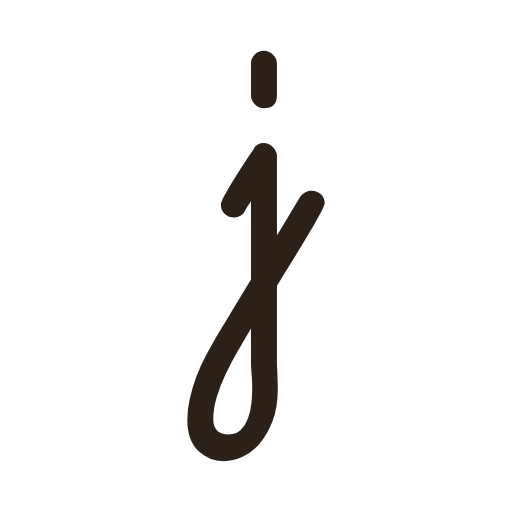
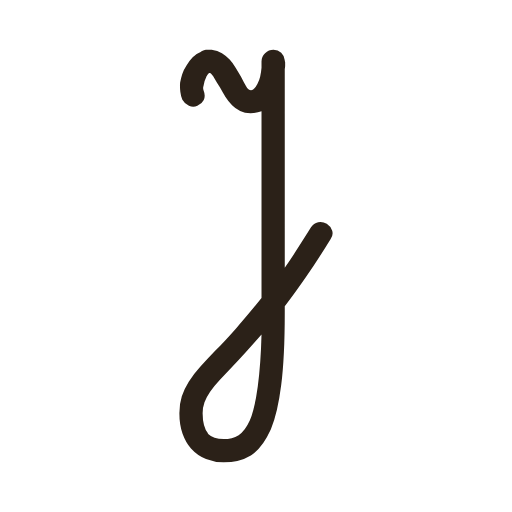
J is the 10th letter of the German alphabet, representing a palatal approximant /j/, corresponding to the consonant sound of English 'yes' or German 'Jahr'. In Sütterlinschrift, it was redesigned in 1911 by Ludwig Sütterlin with upright, geometric proportions for German schoolchildren.
In words
Jahr · year
History
The letter J is the 10th letter of the German alphabet. Phonetically, it represents a palatal approximant /j/, corresponding to the consonant sound of English 'yes' or German 'Jahr'.
Sütterlin lowercase j features an upright middle stroke descending into a round loop below the baseline, with a dot above. Unlike older Kurrent, Sütterlin introduced a clear graphical distinction for capital J by extending its stem down into the lower zone as a true descender loop.
The letter j is common in calendar dates ('Januar', 'Juni', 'Juli'), given names ('Johann', 'Josef', 'Jakob'), and temporal markers ('Jahr', 'jetzt'). Recognizing its descender loop distinguishes it from middle-zone vowels in cursive script.
J shares its origin with i: the Etruscans used one sign both for the vowel i and for the semivowel j,[1] and the Romans kept that use unchanged.[2] In late antiquity the semivowel became a voiced affricate, dzh, in most varieties of Latin,[3] yet the sounds were still written with the same sign until early modern times.[4]
Sources
- [1] J — Wikipedia (German) — one sign for i and j (accessed 2026-10-14)
- [2] J — Wikipedia (German) — Romans kept the use (accessed 2026-10-14)
- [3] J — Wikipedia (German) — late-antique dzh (accessed 2026-10-14)
- [4] J — Wikipedia (German) — one sign until early modern times (accessed 2026-10-14)