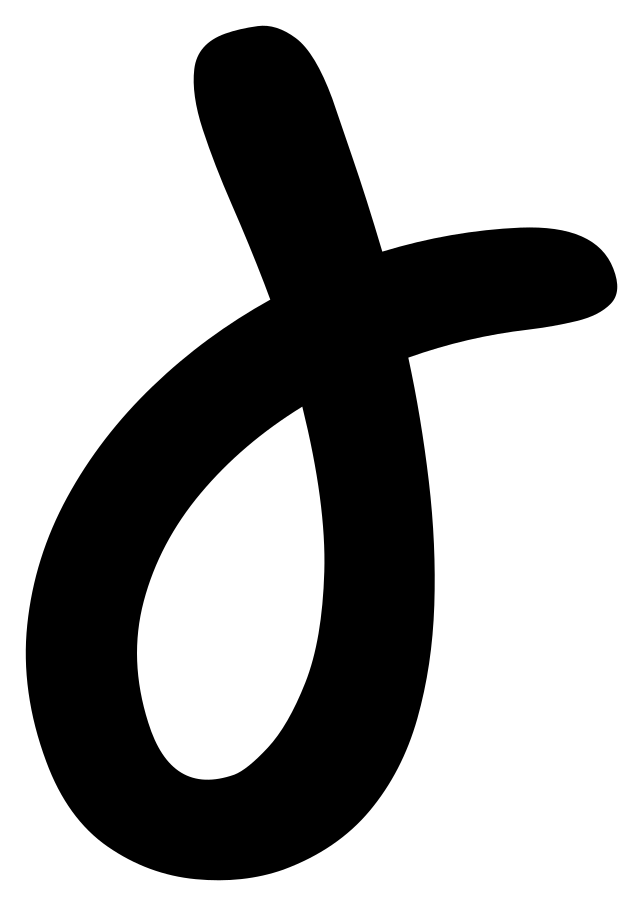
ע — the Hebrew cursive letter עין
ע (ayin) is the 16th letter of the Hebrew alphabet, representing a glottal stop /ʔ/ or silent letter in Ashkenazi and modern Hebrew, historically the voiced pharyngeal fricative /ʕ/; in Yiddish, it serves as the standard vowel letter for /e/.
Nothing to confuse it with.
- Printed
- ע
- Name
- עין (ayin)
- Transliteration
- ʿ
- IPA
- /ʔ/, /ʕ/
- Position
- 16 of 22
History
ע is the 16th letter of the Hebrew alphabet and has a numerical value of 70. In traditional and modern Hebrew and Yiddish, it represents a glottal stop /ʔ/ or silent letter in Ashkenazi and modern Hebrew, historically the voiced pharyngeal fricative /ʕ/; in Yiddish, it serves as the standard vowel letter for /e/.
Cursive ayin is rendered with a flowing rounded gesture, dropping down into an open curve before sweeping rightwards, unlike the rigid y-shaped angular branches of the printed letter. The cursive style emerged across medieval and early modern Jewish communities as a rapid, everyday script for secular, commercial, and personal writing. Unlike the formal square bookhand (stam) reserved for Torah scrolls, liturgical texts, and religious codices, Hebrew cursive evolved to minimize pen lifts and speed up continuous writing.
Across Eastern and Central Europe, Ashkenazi cursive (the direct ancestor of modern Hebrew cursive) became the standard hand used by millions of Yiddish and Hebrew writers. Personal correspondence, family postcards, merchant account books, communal registers (pinkasim), and rabbinic responsa were almost exclusively penned in this fluid hand. Because cursive letterforms diverge significantly from printed typography, individuals fluent only in printed Hebrew frequently find original family letters illegible without paleographic training.
Because Yiddish uses ayin as its primary representation for the vowel /e/, cursive ayin occurs on almost every line of Yiddish epistolary handwriting. Mastering the handwritten ductus of ayin and understanding its positional variants is essential for anyone transcribing historical documents and genealogical correspondence from the eighteenth to twentieth centuries.
Have a document with this letter in it? Upload a photo and we will read the whole page.
Upload a document