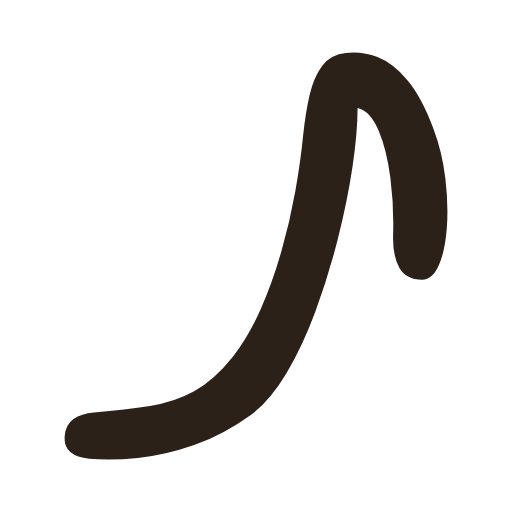
ת, the Hebrew cursive letter tav
ת (tav) is the 22nd letter of the Hebrew alphabet, representing the voiceless alveolar plosive /t/, historically alternating with /s/ in Ashkenazi tradition (without dagesh).
In words
מכתב · letter
בית · house
שבת · Sabbath
Easy to confuse with
Looks like ח (het (ח))
The tav's left stroke is shaped like a nun; if that shape is not clear, the tav reads as a het.
History
ת is the 22nd letter of the Hebrew alphabet and has a numerical value of 400. In traditional and modern Hebrew and Yiddish, it represents the voiceless alveolar plosive /t/, historically alternating with /s/ in Ashkenazi tradition (without dagesh).
Cursive tav consists of a curved right arch and a descending left stroke with a bottom foot, often joined into a single connected loop by rapid cursive writers.
As the final letter of the alphabet, tav marks feminine grammatical suffixes, past-tense verb endings, and appears extensively in calendar year notations (representing four hundred).
Tav is the last letter of emet, truth,[1] and the midrash explains that emet is made of the first, middle and last letters of the alphabet: alef, mem and tav.[2] Sheqer, falsehood, is made of the 19th, 20th and 21st letters.[3] In Yemen and some Sephardi areas tav without a dagesh was a voiceless dental fricative, /θ/, while tav with the dagesh is the plosive /t/.[4]
Sources
- [1] Taw — Wikipedia — last letter of emet (accessed 2026-10-14)
- [2] Taw — Wikipedia — first, middle, last (accessed 2026-10-14)
- [3] Taw — Wikipedia — sheqer (accessed 2026-10-14)
- [4] Taw — Wikipedia — Yemenite /θ/ (accessed 2026-10-14)