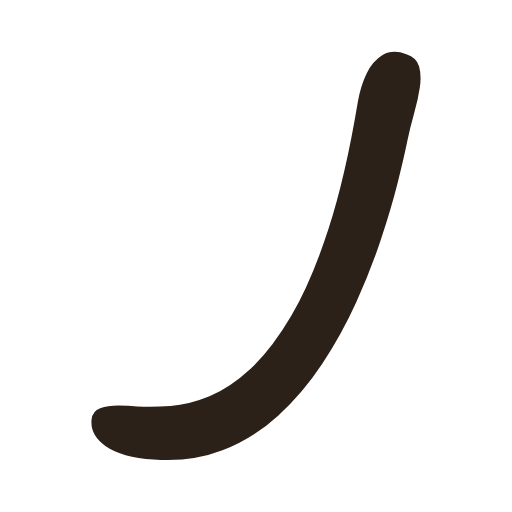
נ, the Hebrew cursive letter nun
נ (nun) is the 14th letter of the Hebrew alphabet, representing the voiced alveolar nasal /n/; word-finally, it takes the straight vertical descender form ן (nun sofit).
Easy to confuse with
Looks like ו (vav (ו))
The final nun (ן) goes down below the line; the vav is shorter and stops at the bottom line.
History
נ is the 14th letter of the Hebrew alphabet and has a numerical value of 50. In traditional and modern Hebrew and Yiddish, it represents the voiced alveolar nasal /n/; word-finally, it takes the straight vertical descender form ן (nun sofit).
Cursive nun is formed with a small upper hook and short base stroke. In its final form (ן), it is written as a long, straight vertical downward stroke descending beneath the baseline.
Final nun is extremely common at the end of Yiddish infinitives, verb forms, and Hebrew plural suffixes, and its descender length serves as a key visual marker on handwritten pages.
Nun is believed to come from an Egyptian hieroglyph of a snake, and the Hebrew word for snake, nakhash, begins with nun.[1] The Tanakh has nine instances of an inverted nun.[2] The final form represents 700, but this is rarely used; tav and shin, 400 + 300, are written instead.[3] In the game of dreidel, a rolled nun passes play to the next player with no other action.[4]
Sources
- [1] Nun (letter) — Wikipedia — hieroglyph of a snake (accessed 2026-10-14)
- [2] Nun (letter) — Wikipedia — nine inverted nuns (accessed 2026-10-14)
- [3] Nun (letter) — Wikipedia — final nun 700, rarely used (accessed 2026-10-14)
- [4] Nun (letter) — Wikipedia — dreidel (accessed 2026-10-14)