Kurrent transcription and translation
Deutsche Kurrentschrift was the everyday cursive of German-speaking Europe for four centuries. Take a photo of any Kurrent document. FamilyLore provides a line-by-line German transcription, an English translation, and marks on doubtful words.
Your first three pages need no account and no card.
A Kurrent document from our shelf, as FamilyLore read it
A dotted underline marks a word FamilyLore was unsure of; [?] is its own note on a doubtful reading.
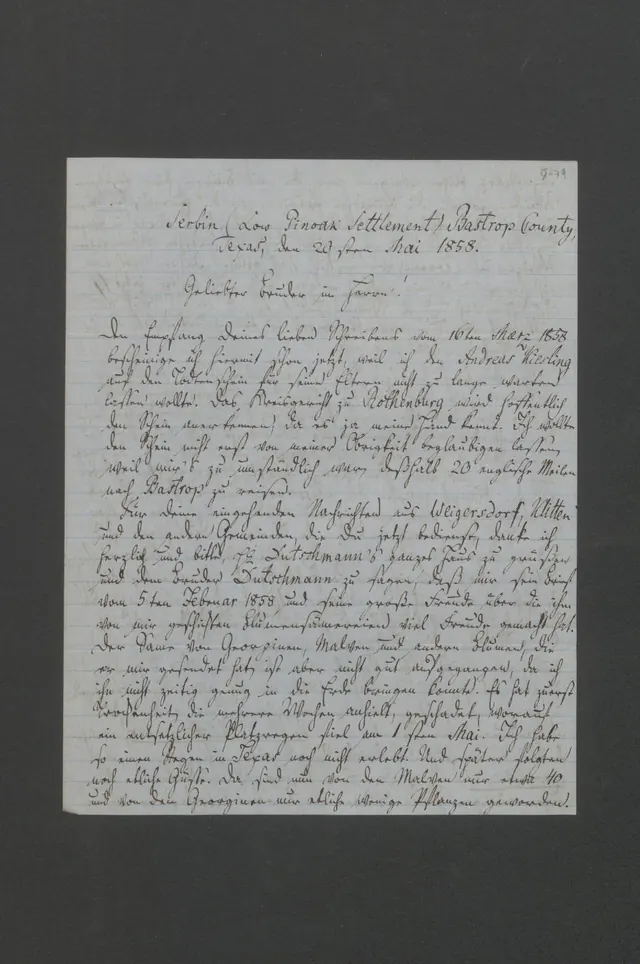
Johann Kilian to Gotthold Albert Gumlich · 20 May 1858
- Serbin (Low Pinoak Settlement) Bastrop County,
- Texas, den 20sten Mai 1858.
- Geliebter Bruder im Herrn!
- Den Empfang Deines lieben Schreibens vom 16ten März 1858
- bescheinige ich hiermit schon jetzt, weil ich den Andreas Kiesling[?]
- auf den Todtenschein für seine Eltern nicht zu lange warten
- lassen wollte. Das Kreisgericht zu Rothenburg wird hoffentlich
- den Schein anerkennen, da es ja meine Hand kennt. Ich wollte
- den Schein nicht erst von meiner Obrigkeit beglaubigen lassen,
- weil mir's zu umständlich war, deßhalb 20 englische Meilen
- nach Bastrop zu reisen.
Also on the shelf: Leo Meter’s 1943 Easter letter in Sütterlin · Käthe Kollwitz’s 1914 field letter in Kurrent
How well it reads, measured
| Script | Pages | Characters read correctly | Names, dates and numbers right | Misread words it marked | Last run |
|---|---|---|---|---|---|
| Kurrent and Sütterlin15 pages · 3 Nov 2026 | 15 | 83%Characters read correctly | 75%Names, dates and numbers right | 85%Misread words it marked | 3 Nov 2026 |
Measured on letters whose holders published a transcription made by hand, read the same way your page is. The figures rest on a few pages so far and move as pages are added. How well FamilyLore reads
Questions
- Can’t ChatGPT do this?
- A general chatbot can read some Kurrentschrift, sometimes well, but it usually hands you clean text with no sign of which words it guessed, and its makers publish no figures for this script; FamilyLore marks the words it is unsure of and publishes how often it reads correctly, in the table above.
- What if it reads a word wrong?
- Tap a word to see the other readings FamilyLore weighed, and correct it if you know better. The translation is redone from your correction. Most misread words carry a mark, but not every one, so a name or a date that matters is worth checking against the photo.
- What distinguishes Kurrent from Sütterlin?
- Kurrent is the pointed, slanted cursive used from the 16th century until 1941. Sütterlin is a standardized, upright school hand developed in 1911 and taught from 1915 to 1941. Both are recognized under our German hand model.
- Who sees my pages?
- Only you. A page becomes public only if you share it, and then only to people who have the link. Deleting your account deletes the photos you uploaded.
What FamilyLore doesn’t read well yet
- Early modern 16th- and 17th-century chancery hands with obscure scribal ligatures.
- Tabular census and church registers arranged in multi-column tables.
- Latin language text embedded in German parish records (unmeasured).
From photo to text in three steps
Take a photo of the page
Lay the sheet flat, in daylight and without flash. A phone photo of the whole page is enough.
Upload it
“German (Kurrent)” is already chosen. If you know roughly when it was written, pick the era.
Read it
You get the page as it was written, in modern spelling, and in English. Correct a word you know better yourself.
Rather read it yourself?