Read Polish records in Russian
From 1868 until 1917, civil registration records in Congress Poland were recorded in Russian rather than Polish. These birth, marriage, and death acts use pre-1918 Russian cursive with Polish names and dates. FamilyLore transcribes the Russian cursive and translates it into English.
Your first three pages need no account and no card.
Pre-1918 Russian official handwriting, as read
A dotted underline marks a word FamilyLore was unsure of; [?] is its own note on a doubtful reading.
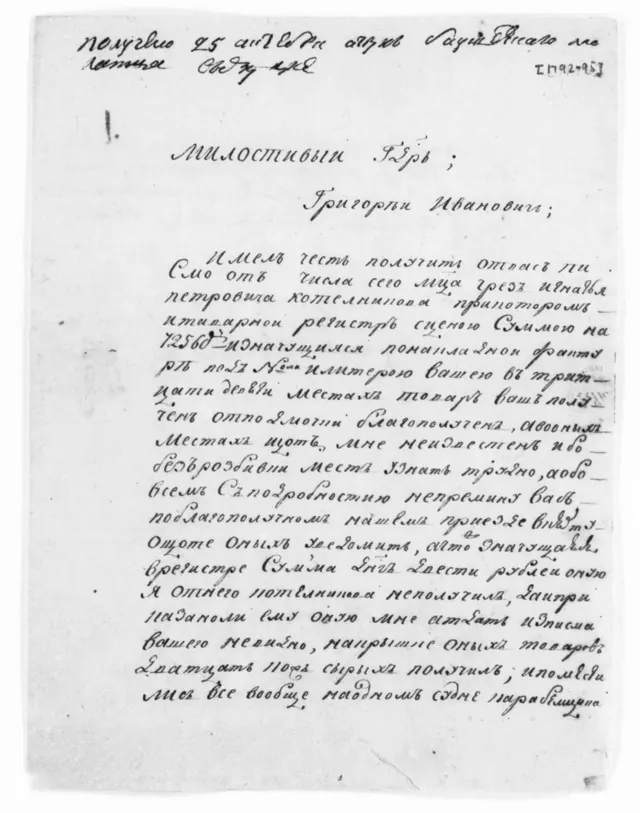
Matvei Lapatin to Grigorii Shelikhov · 24 Oct 1792
- Милостивый Гдрь;
- Григорьи[?] Ивановичь;
- Имелъ честь получить отвас пи
- Смо отъ числа сего мца чрезъ игнатья
- петровича котелникова прикоторомъ
- итоварной регистръ сценою Суммою на
- 7256[?] р.[?] изначущимися понакладной фанту[?]
Also on the shelf: V. K. Arsenyev’s 1910 letter in pre-1918 Russian
How well it reads, measured
| Script | Pages | Characters read correctly | Names, dates and numbers right | Misread words it marked | Last run |
|---|---|---|---|---|---|
| Russian and Ukrainian7 pages · 3 Nov 2026 | 7 | 86%Characters read correctly | 69%Names, dates and numbers right | 80%Misread words it marked | 3 Nov 2026 |
Measured on pre-1918 Russian handwriting. Church and civil registers arranged in tabular columns are not yet measured. How well FamilyLore reads
Questions
- Can’t ChatGPT do this?
- A general chatbot can read some Russian vital records, sometimes well, but it usually hands you clean text with no sign of which words it guessed, and its makers publish no figures for this script; FamilyLore marks the words it is unsure of and publishes how often it reads correctly, in the table above.
- Why were Polish records written in Russian?
- Following the January Uprising of 1863, the imperial Russian administration required parish priests and civil registrars in Congress Poland to keep all official vital registers in the Russian language starting in 1868. This practice continued until the end of Russian administration during World War I in 1917.
- Can FamilyLore read records written in Polish?
- Yes, as a language of its own, though few Polish pages are measured so far. The page on reading old Polish records has the details; this page promises the Russian-language records from 1868 to 1917. Records from before 1868 are usually in Polish or Latin, and Latin is not offered yet.
- What if it reads a word wrong?
- Tap a word to see the other readings FamilyLore weighed, and correct it if you know better. The translation is redone from your correction. Most misread words carry a mark, but not every one, so a name or a date that matters is worth checking against the photo.
- Who sees my pages?
- Only you. A page becomes public only if you share it, and then only to people who have the link. Deleting your account deletes the photos you uploaded.
What FamilyLore doesn’t read well yet
- Registers and vital books set out in columns. Tabular records are not yet measured, so we cannot report how well FamilyLore reads them.
- Parish records in Latin from before 1868: there’s no Latin choice on the upload yet. Polish ones are read, but few Polish pages are measured so far.
- The benchmark currently includes few Russian pages. Always verify extracted names and dates against the original image.
From photo to text in three steps
Take a photo of the page
Lay the sheet flat, in daylight and without flash. A phone photo of the whole page is enough.
Upload it
“Russian or Ukrainian, Before 1918” is already chosen.
Read it
You get the page as it was written, in modern spelling, and in English. Correct a word you know better yourself.
Rather read it yourself?