Read and translate a Yiddish letter
Yiddish family letters were written in Hebrew cursive script, often in regional Ashkenazi handwriting. Take a photo of the letter. FamilyLore transcribes the Hebrew characters and translates the text into English, marking words it is unsure of.
Your first three pages need no account and no card.
A Hebrew script letter from our shelf, as read
A dotted underline marks a word FamilyLore was unsure of; [?] is its own note on a doubtful reading.
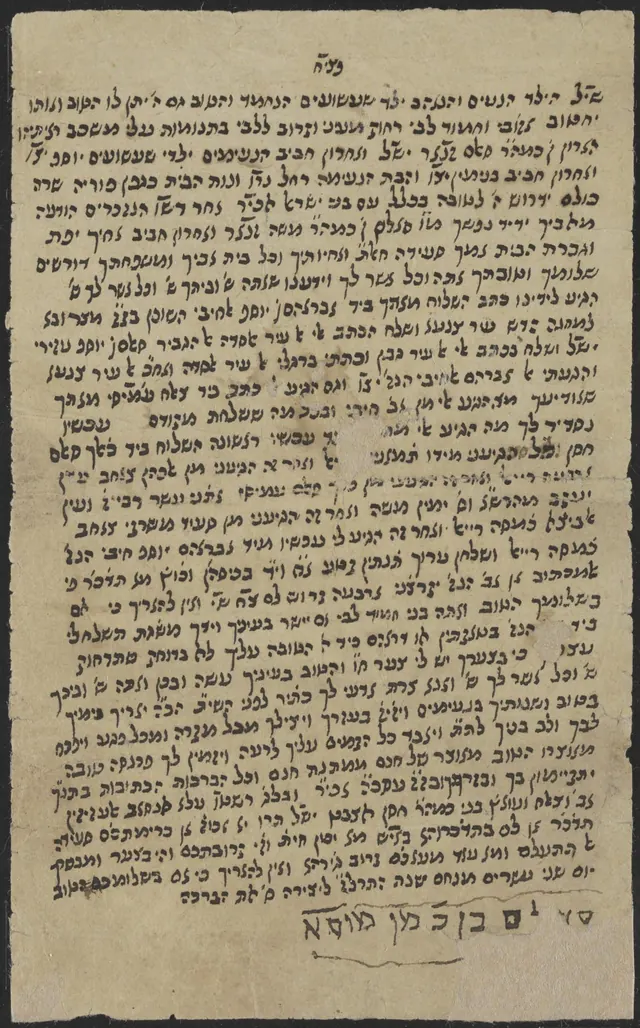
Salem b. Musa to his wife and children · 20 Av 5637 (1877)
- בע"ה
- ה"ל [?] הילד הנעים והנחמד ילד שעשועים הנחמד והטוב גם ה' יתן לו הטוב ונוהו [?]
- יהטוב [?] לטוב והחמוד לבי רחוק מעיני וקרוב ללבי בתנומות עלי משכב ובקיצין [?]
- האדון ן' כמוהר"ר [...] נר"ו יש"ל והאדון חביב הנעימים ילדי שעשועים יוסף נ"י
- והאדון חביב [...] יצ"ו [?] ובת הנשמה רחל נ"ה ונות הבית כגפן פוריה שרה
- כולם ידרוש ה' לטובה בכלל עם בני ישראל אכי"ר אחר דש"ה הנזכרים הודעה
How well it reads, measured
| Script | Pages | Characters read correctly | Names, dates and numbers right | Misread words it marked | Last run |
|---|---|---|---|---|---|
| Hebrew and Yiddish6 pages · 3 Nov 2026 | 6 | 34%Characters read correctly | 15%Names, dates and numbers right | 100%Misread words it marked | 3 Nov 2026 |
Benchmark measurements for Hebrew and Yiddish script are in progress and will appear here when completed. How well FamilyLore reads
Questions
- Can’t ChatGPT do this?
- A general chatbot can read some Yiddish handwriting, sometimes well, but it usually hands you clean text with no sign of which words it guessed, and its makers publish no figures for these scripts; FamilyLore marks the words it is unsure of and publishes how often it reads correctly, in the table above.
- What if it reads a word wrong?
- Tap a word to see the other readings FamilyLore weighed, and correct it if you know better. The translation is redone from your correction. Most misread words carry a mark, but not every one, so a name or a date that matters is worth checking against the photo.
- Why does the shelf sample show a Hebrew letter?
- FamilyLore uses the same Hebrew cursive OCR model for Yiddish and Hebrew manuscripts. We are awaiting copyright clearance on authentic Yiddish family letters before publishing them to the shelf.
- Who sees my pages?
- Only you. A page becomes public only if you share it, and then only to people who have the link. Deleting your account deletes the photos you uploaded.
What FamilyLore doesn’t read well yet
- Hebrew and Yiddish benchmark rows are not yet measured, so accuracy figures are not published yet.
- Micrography and liturgical calligraphy with specialized abbreviations.
- Documents written in Judeo-Arabic or Judeo-Spanish (Ladino).
From photo to text in three steps
Take a photo of the page
Lay the sheet flat, in daylight and without flash. A phone photo of the whole page is enough.
Upload it
“Yiddish” is already chosen. If you know roughly when it was written, pick the era.
Read it
You get the page as it was written, in modern spelling, and in English. Correct a word you know better yourself.
Rather read it yourself?